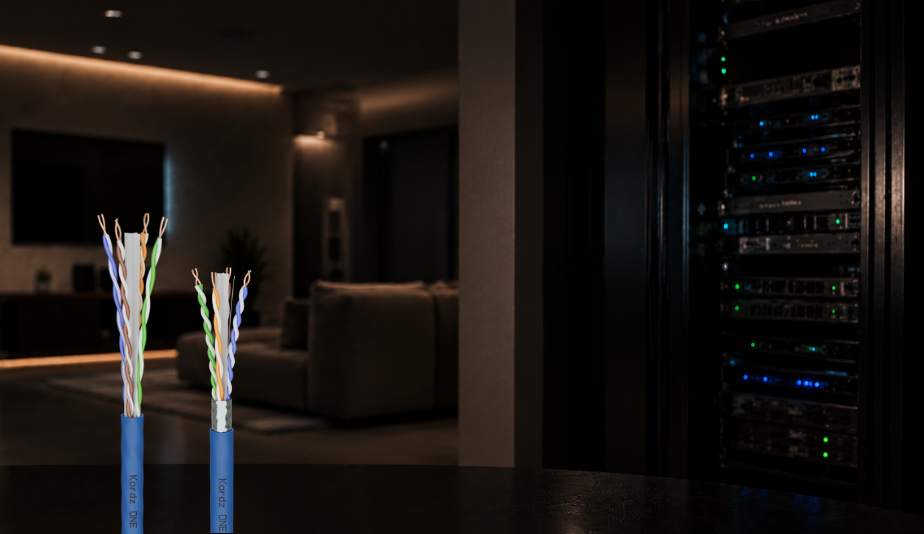
Shielding is a cabling product feature that protects the cable’s signal from electrical interference. It is beneficial for installation environments where there is a real risk of electrical interference, such as dense AV racks, lighting control routes and retrofit pathways running near power. It is not a performance upgrade.
Most residential and light-commercial AV installations do not require shielding. If the risk of interference is minimal, unshielded cable – correctly installed – is the right call, otherwise it can lead to other unnecessary complications.
One rule applies regardless: if you specify shielded cable, the entire channel must be shielded for it to work properly.
Why Shielding Decisions Matter
Shielded cable currently gets overspecified by default on plenty of residential AV projects without a clear project-specific reason. That adds cost, increases termination complexity, and if the installation discipline is not there to support it, provides no practical benefit whatsoever.
Underspecifying, however, also carries risks. Unshielded cable in an environment with genuine interference sources can produce intermittent signal issues and unreliable behaviour. That kind of fault is frustrating to diagnose on site and rarely obvious until the client starts loading up the network in everyday use.
The right specification depends on the project. This article explains how to make that call:
Choosing the Right Network Cable: Performance, Environment and Future Requirements.
What Shielding Actually Does
The shield, whether it’s in a foil wrap or braided screen format, reduces the effect of external electromagnetic interference on the signal pairs inside the cable. In AV terms, that interference tends to show up as dropouts, intermittent link failures or unreliable control behaviour, the kind of symptoms that are easy to misdiagnose and can have you and your client both pulling your hair out.
Shielding also works in both directions. Shielded cable reduces the EMI the cable itself emits, which is worth considering where data runs sit close to audio infrastructure or sensitive control wiring.
In a clean residential installation with sensibly routed cabling and no significant interference sources nearby, there is nothing for the shield to manage. So, the benefit only really exists where the environmental risk exists.
It is worth noting that Cat6A cable is often supplied in shielded constructions because shielding is a practical way to manage alien crosstalk and maintain performance margin. In those cases, shielding may feature as a consequence of the category selected, not because the environment itself demanded shielding. Either way, the same rule applies: specify deliberately and install consistently.
What Shielding Does Not Do
Shielding does not increase cable speed or category performance. A shielded Cat6 cable is still a Cat6 cable.
Shielding does not compensate for poor termination either; badly terminated shielded cable can perform worse than well-terminated unshielded cable – an uncomfortable truth for anyone who has defaulted to shielded cable on the assumption it would cover the bases.
It will also not fix poor routing decisions. Where data cable runs close to mains wiring, physical separation is the correct first response. Shielding is a secondary measure, not a substitute for good cable management.
Put simply, shielding does not reduce the need for installation discipline. In many ways, it increases it.
Common Shielding Constructions: U/UTP, F/UTP, U/FTP and S/FTP
Unshielded (U/UTP)
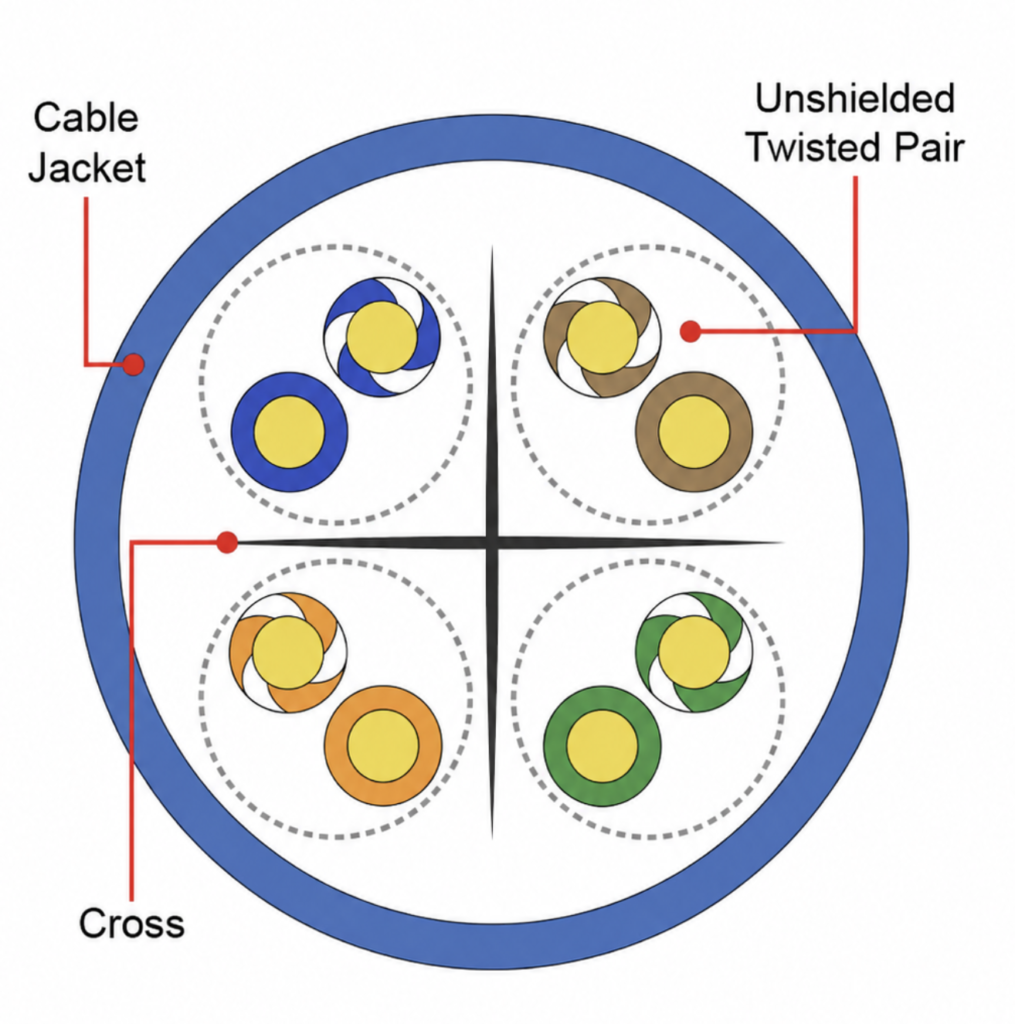
No screen. This is the standard choice for residential and clean light-commercial installations. It’s easier to terminate, and its twisted pair construction provides a degree of interference rejection suitable for low-risk environments, particularly in a solid, well-made cable.
Overall shielded (F/UTP)
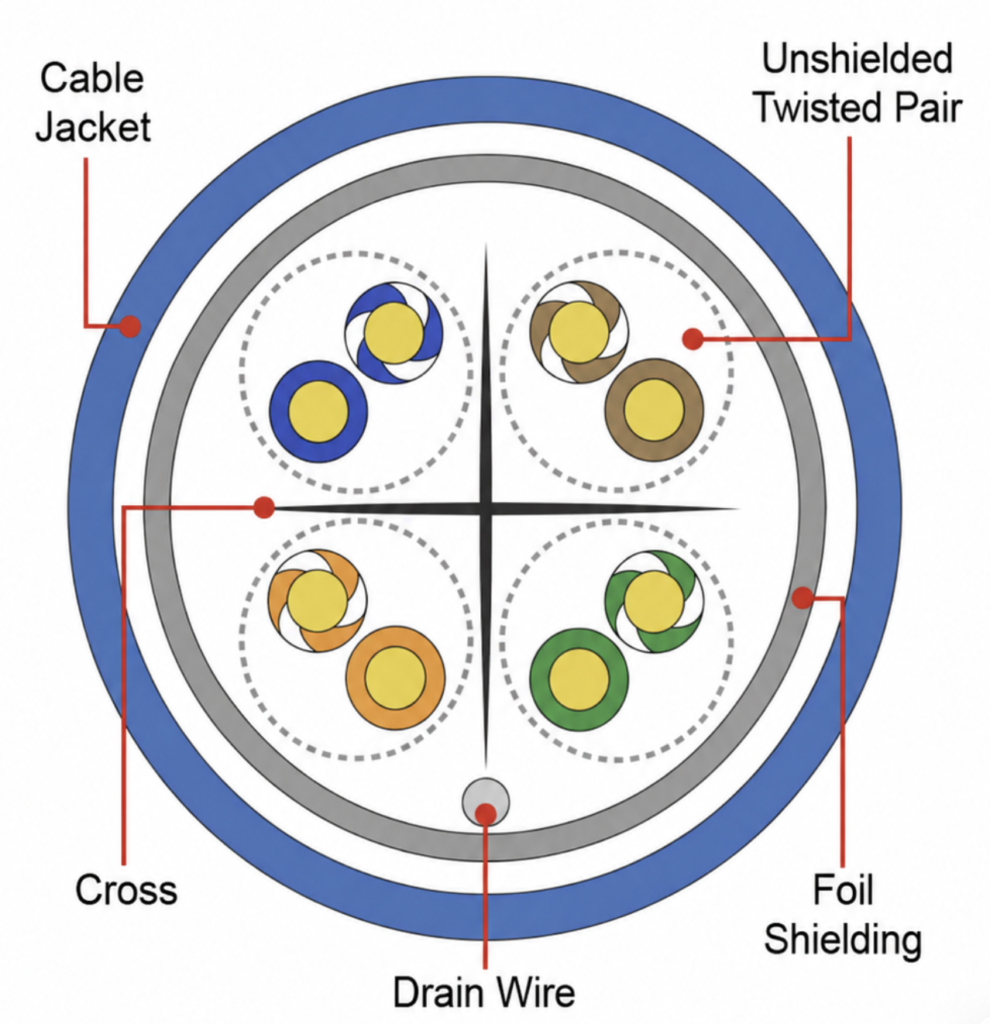
A single foil screen around all four pairs. This is a practical option of environments where moderate interference risk is present, such as equipment cupboards, lighting control routes and retrofit pathways near mains. It is easier to handle than fully shielded cable constructions and suitable for standard termination practice.
Pair-Shielded (U/FTP)
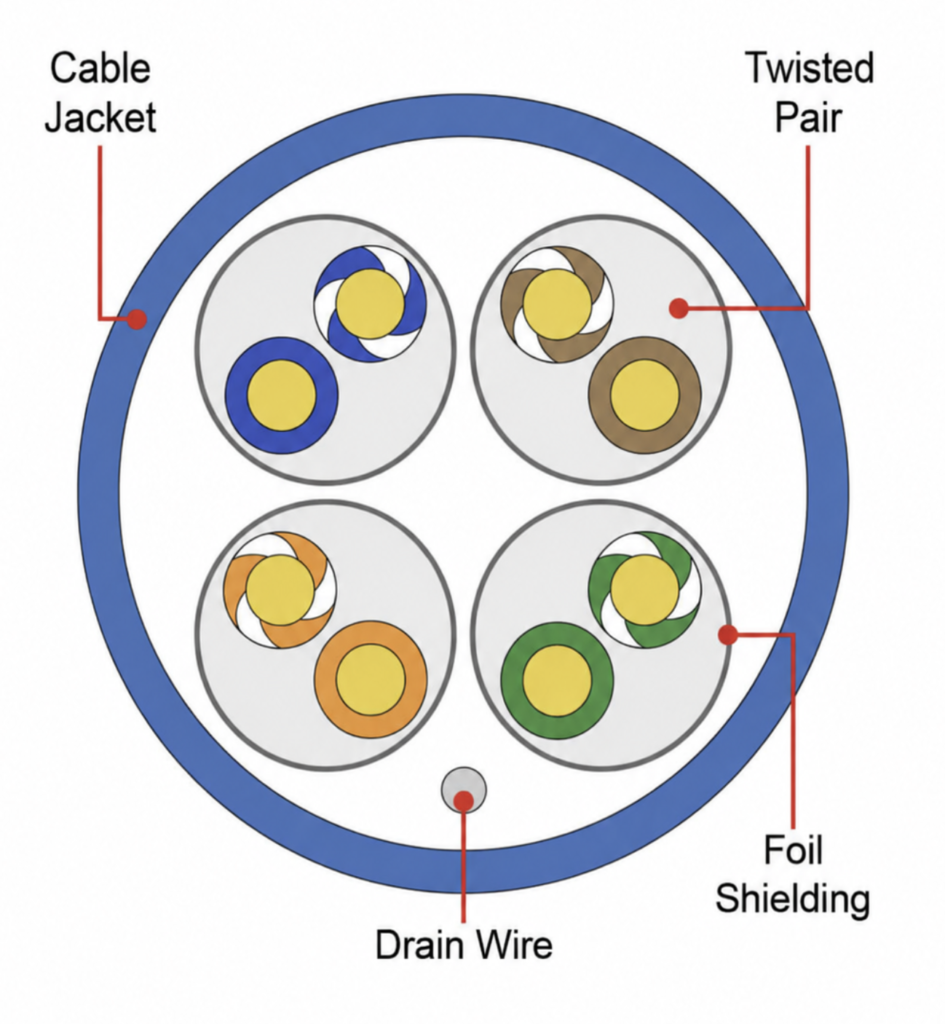
Individually foil screened pairs without an overall shield. It is primarily intended for environments where additional pair isolation and crosstalk control is beneficial. It is more demanding to terminate and route than unshielded cable, and not the default choice for residential AV. Consistent termination quality throughout the channel is essential.
Fully shielded (S/FTP or SF/FTP)
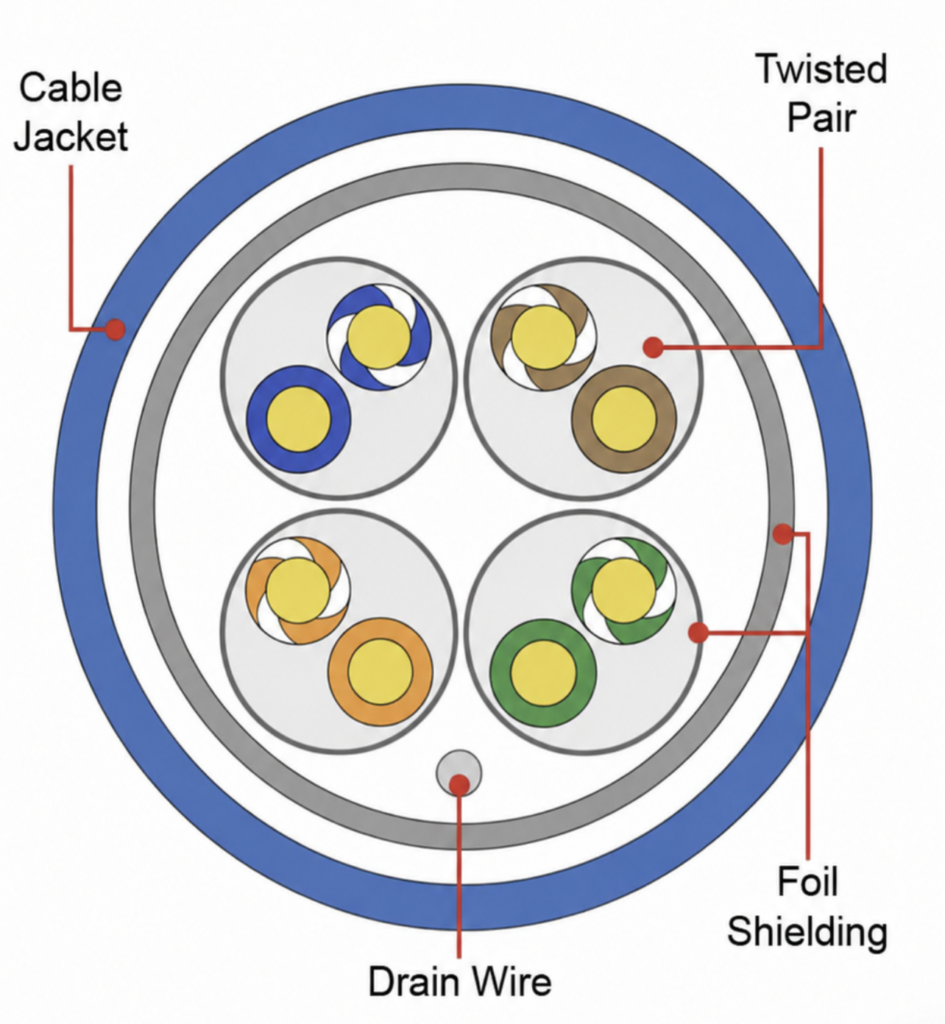
Individually foil screened pairs with an overall braid on top. This is one of the most comprehensively shielded constructions and one the most demanding to terminate and route. It is reserved for the highest interference environments. These are specialist installations that require a complete shielded channel and a high level of termination discipline throughout the installation.
Assessing EMI Risk in Residential or Light-Commercial AV
The first question to ask on any network project is straightforward: is there a credible source of electromagnetic interference near the cable route?
The assessment should always be pathway-specific, as not every cable run in a building carries the same risk. Each route should be assessed against the environment it actually passes through, rather than applying a single shielding specification across the whole project.
Low or negligible risk: Unshielded cable is correct
Unshielded cable is generally the correct specification for these conditions:
- Clean residential installations with dedicated data cable routes
- Proper separation from power
- Standard domestic electrical loading
- No heavy equipment, no specialist systems nearby.
Moderate risk: Consider overall shielded cable
Shielded cable is a sensible and practical option for these environments:
- Dense AV racks and equipment cupboards where data cables run close to power supplies, amplifiers and switching equipment
- Lighting control cabinets where phase-cut dimming systems can be notoriously electrically noisy
- Distributed audio racks with multiple power amplifiers and transformers in a confined space
- Retrofit pathways where new data cable cannot avoid running near existing mains wiring
- Larger multi-room AV installations with complex lighting infrastructure and motorised equipment, projector lifts and motorised screens.
Higher risk: Shielded cable is a sensible specification
Fully shielded cable constructions may be justified for these conditions:
- MDU installations and shared risers where cable runs alongside other building services, tenant wiring or significant electrical infrastructure
- Large residential buildings where cabling must pass near plant rooms, lift motor rooms or significant HVAC infrastructure
- Certain prime residential projects, which in practical terms, are small hotels with a family living in them, and the electrical environment reflects this.
- EV charging infrastructure, as charger wiring carries high current and can interfere with adjacent data routes.
Shielding and PoE are separate considerations. The decision to use shielded or unshielded cable should be driven primarily by the installation environment and EMI risk. PoE performance is more heavily influenced by conductor size, cable quality, bundle size and installation practice than by the presence of shielding alone.
When Unshielded Cable Is the Right Choice
For the vast majority of residential and light-commercial AV installations, unshielded cable that is correctly installed, terminated well and routed with care remains the correct specification.
To be clear – it is not a ‘budget option’ or a compromise – it’s situation-specific. Unshielded cable is generally best for standard residential AV and smart home installations in clean electrical environments, for dedicated data cable routes with good separation from power, control and automation endpoints, and for new-build projects where the cabling infrastructure has been designed sensibly from the outset.
System Integrity and Shielding: Why the Whole Channel Matters
The protection shielding delivers requires continuity from end-to-end. Therefore, when shielded cable is specified, the commitment must extend to the entire channel. That means it must be specified with shielded connectors, shielded patch leads, shielded patch panels and correctly bonded rack infrastructure.
Mixing shielded and unshielded components within the same channel is one of the more common mistakes made on site. For example, a shielded home run terminated into an unshielded keystone jack at the AP or patch panel significantly undermines the channel.
Bonding and earthing also need proper attention. Done poorly, shielding can become less effective and may introduce unintended noise issues, rather than reduce them.
Shielding only properly works as intended when the network channel has been designed to support it. In residential AV installations, this can be a lot more complex than the average installer realises. Indeed, not all active equipment provides a bonded shield connection at the network port, and shield continuity alone does not guarantee effective grounding. Shielded systems should therefore be specified with the complete channel and earthing strategy in mind.
As always, follow local regulations, manufacturer guidance and the earthing design for your specific installation.
Installation Complexity and Trade-Offs
Nothing in life comes for free and shielded cable is no exception. It not only costs more money than unshielded cable, it is also costs space, as it is thicker, less flexible and takes up more room in ceiling voids, conduit runs, compact risers and busy rack enclosures.
Cable termination for shielded cable also requires more care; the handling of drain wires, exposed foil at the connection point and inconsistent shield continuity are all practical risks that do not apply in the same way to unshielded cable.
In retrofit work, the reduced flexibility is a real consideration. Pulling shielded cable through existing pathways is harder, and in tight or convoluted routes that additional stiffness is quickly felt.
None of this is a reason to avoid shielded cable where the environment genuinely warrants it. It is a reason to specify it deliberately rather than use it by default.
Common Specification and Installation Mistakes
- Specifying shielded cable across an entire project without assessing the actual interference risk on each cable route is the most common mistake, which adds unnecessary cost and complexity.
- Terminating shielded cable into unshielded keystones or patch leads is also a very common issue. This often occurs because the right connector wasn’t on the van; however, it effectively breaks the shielded channel at the point of termination.
- Leaving drain wires or foil tails unconnected is a termination mistake that renders the shielding largely ineffective regardless of cable quality.
- Using shielded cable as a workaround for poor routing decisions. Separation from power cabling should always be the first response to interference risk, not an afterthought addressed with a shielding specification.
- Not using shielded cable in retrofit situations where mains proximity genuinely cannot be avoided. Under-specifying is a mistake that may show up later as head-scratching signal issues.
- Poor termination quality. It goes without saying that termination quality ultimately determines whether any cable type performs to specification, and that applies equally to shielded and unshielded cable.
Shielded vs Unshielded Cable Decision-Making Guide
| Installation scenario | EMI risk | Recommended approach | Practical note |
|---|---|---|---|
| Standard residential AV with clean dedicated data pathways. | Low | Unshielded | Correct for most residential AV installations where routes are well separated from interference sources. |
| Smart home and control endpoint | Low | Unshielded | Low-bandwidth control wiring in domestic environments does not warrant shielded cable. |
| Equipment cupboard or rack with dense power supplies and AV equipment in close proximity | Low to moderate | Overall shielded or unshielded | Where cables bundle tightly near transformers or dense power supplies, overall shielded patch leads are a sensible precaution. Assess the specific conditions rather than defaulting to full shielding throughout. |
| Lighting control: leading edge and trailing edge dimming systems sharing cable routes | Moderate | Overall shielded | Dimming and lighting control infrastructure can introduce interference on shared or adjacent cable routes. |
| Cinema room or dedicated AV equipment room with high rack density | Moderate | Overall shielded | Dense AV racks with multiple power supplies, amplifiers and switching equipment create localised interference risk. |
| Retrofit installation: cable routed near existing mains wiring, limited separation | Moderate | Overall shielded | Retrofit pathways rarely allow ideal separation from power. Where runs parallel to mains cabling at close proximity, overall shielded cable reduces interference risk. Routing separation should still be maximised where possible. |
| MDU / shared risers: cable alongside other tenants’ wiring and building services | Moderate to high | Overall shielded or fully shielded | Shared infrastructure in multi-dwelling or mixed-use buildings introduces unpredictable interference sources. Assess the specific pathway. Overall shielded cable is often sufficient; fully shielded is warranted where electrical loading is significant. |
| Large residential or mixed-use building with plant room, lifts or HVAC nearby | High | Fully shielded | Where data cable must run near plant equipment or building services with credible EMI sources, fully shielded cable within a complete shielded channel is the appropriate specification. |
Related Kordz Solutions
| Recommended specification | Consider this Kordz solution | Why it fits |
|---|---|---|
| Unshielded Cat6 for standard residential AV and clean data pathways | Kordz ONE Cat6 U/UTP Network System | A robust home-run option for residential and light-commercial network infrastructure where shielding is not required. |
| Unshielded Cat6 where space is tight or cable density matters | Kordz PRO SlimCat Cat6 U/UTP Network Cable System | Designed for compact pathways, dense racks and retrofit work where reduced cable bulk helps installation and serviceability. |
| Overall shielded Cat6A for moderate EMI risk | Kordz ONE Cat6A F/UTP Network System | A practical shielded option for routes near dense AV equipment, lighting control infrastructure or other credible interference sources. |
| Shielded Cat6A where space is also constrained | Kordz PRS SlimCat Cat6A F/UTP Network Cable System | Combines Cat6A F/UTP shielding with a slimmer format for high-density, retrofit and space-limited installations. |
| Rack patching for unshielded Cat6 channels | Kordz PRO SlimCat Cat6 U/UTP Patch Cords | Slim, flexible patch cords for high-density racks, switch connections and endpoint patching where an unshielded Cat6 channel is appropriate. |
| Rack patching for shielded Cat6A channels | Kordz PRS SlimCat Cat6A U/FTP Patch Cords | Shielded Cat6A patch cords for maintaining channel consistency at rack and endpoint connections in shielded network systems. |
| Structured rack termination and channel organisation | Kordz PRO Modular Keystone Patch Panel | Supports clean rack termination and serviceability when paired with the appropriate shielded or unshielded Kordz keystone sockets. |
| A complete shielded or unshielded channel | Matched Kordz cable, connectors, keystones, patch cords and patch panels | Helps maintain channel consistency from cable to termination, avoiding the common mistake of mixing shielded and unshielded components within the same channel. |
Related Topics
Choosing the Right Network Cable: Performance, Environment and Future Requirements: Understand what influences cable selection.
Designing Network Infrastructure for Wi-Fi 7 and Wi-Fi 6E:
PoE Demystified: Power, Performance and Cable Considerations: Learn how power delivery impacts cable performance, heat and long-term system reliability.
Cat6 vs Cat6A: Category, Performance and Installation Requirements
Cable category and shielding solve different specification challenges. Compare Cat6 and Cat6A based on bandwidth, distance, PoE, installation density and expected service life.
FAQs
Does shielded cable improve performance in a standard residential AV installation?
No, shielding manages interference, it does not improve the cable’s underlying performance. In a standard residential environment with sensibly routed cabling and no significant interference sources nearby, well-installed unshielded cable performs reliably. Adding shielding to the specification brings no meaningful benefit because shielding cannot actively improve anything; it stops interference problems from getting worse.
Is shielded cable required for WiFi 6E and WiFi 7 installations?
Not automatically, most residential installations don’t require shielded cable infrastructure. The decision to use shielded or unshielded cable for a WiFi 6E or WiFi 7 deployment is driven by the installation environment and the cable routes involved.
It is, however, generally recommended for installers to use Cat6A cable for new WiFi 6E and WiFi 7 infrastructure, as this will likely need to support multi-gig link speeds.
For detailed guidance on cabling specification for WiFi 6E and WiFi 7, see Designing Network Infrastructure for WiFi 6E and WiFi 7.
Is all Cat6A shielded?
Surprisingly, no. Cat6A defines only the electrical performance specification of the cable. Both shielded and unshielded Cat6A constructions exist, and both meet the same category performance standard.
In practice, many Cat6A cables actually are shielded because it is one of the easier ways to achieve the required performance margins to qualify as Cat6A. This is particularly true where alien crosstalk is concerned.
Over the years, many installers have assumed that Cat6A and shielded Cat cable are one and the same thing because of this – but they are not.
What happens if I use shielded cable with unshielded connectors?
Shielding depends on continuity from the cable, through the connectors, patch leads and rack connections from end to end. Any missing shielded component in the chain compromises the effectiveness of the whole system considerably. Therefore, a shielded channel is only as strong as its weakest link.
It is surprisingly common to find a shielded cable terminated into an unshielded keystone on site, often because the correct parts weren’t available, or from a lack of understanding of the original installer. In some circumstances, incorrectly bonded shielding can become less effective and may introduce unintended noise issues. Unfortunately, this practice largely defeats the purpose of specifying shielded cable in the first place.
Does lighting control infrastructure in a residential project justify shielded cable?
Potentially – it depends on the specific cable pathway. The issue with dimming infrastructure is not the control side but the way phase-cut dimming works, chopping the AC waveform to reduce power to the luminaires.
Leading edge dimming, in particular, produces hard voltage transitions that can introduce interference onto adjacent cable routes. The dimmer hardware and its associated wiring can both contribute to the electrical noise present within the cable route.
Where data cable runs close to dimmers and their associated wiring, overall shielded cable is the practical choice.
Is shielded cable harder to install?
Yes. Shielded cable is heavier, less flexible and more demanding to terminate correctly. In tight retrofit pathways or compact equipment cupboards, the reduced flexibility is a real consideration. That does not make shielded cable the wrong choice – it just means it should be specified deliberately and only where necessary.
Do shielded and unshielded cables carry the same category performance rating?
Category rating and shielding construction are independent of each other. Both shielded and unshielded Cat6 cable carry the same performance specification. This principle also applies to Cat6A cables.
Shielding provides protection from electrical interference in the installation environment; it is not the baseline electrical performance of the cable itself. The two are very often conflated – especially for Cat6A where the most common construction type that installers encounter is shielded. Unshielded Cat6A cables are rarely seen in the wild.
Do shielded cables need grounding?
Yes. This is where shielded installations can silently fail in ways that are hard to predict. A shield that is not correctly bonded to earth cannot drain the induced energy from electromagnetic interference.
In some circumstances, incorrectly bonded shielding can become less effective and may introduce unintended noise issues rather than reducing them.
Bonding must provide continuity through the cable, connectors, patch leads and rack infrastructure throughout the channel. It’s important to note that the bonding must be carefully planned to avoid ground loops where bonding is not equipotential, particularly where different earthing paths exist. This is worth noting but it’s a large topic in its own right, and not one we’ll cover here in detail.
Of course, the installation should follow local electrical regulations, manufacturer guidance and the earthing design for the specific project.
Conclusion
Shielding is a valuable feature when the installation environment warrants it. However, for most residential and light-commercial AV projects with clean pathways and sensible separation from interference sources, correctly installed unshielded cable remains the most pragmatic specification.
Where shielded cable is required, it must be treated as a complete channel. Cable, connectors, patch leads, patch panels and bonding all need to support the same design intent. A partially shielded channel adds complexity without delivering the full benefit.
You can reference this article any time you need information about how to make the best choice for your projects. For more on Kordz’ professional grade networking solutions for shielded and unshielded specifications, click here.
Ready to specify Kordz for your next project?
Explore the Kordz connectivity range or speak with the team about the right solution for your next smart home, AV or networking installation.
© 2026 Kordz International. All Rights Reserved.
Please note, re-publishing of the contents of this article is prohibited; however, Kordz encourages the link to this page to be shared. If media, distributors, educators or others wish to share this information, we request you author your own post or article and link it to this page on kordz.com.