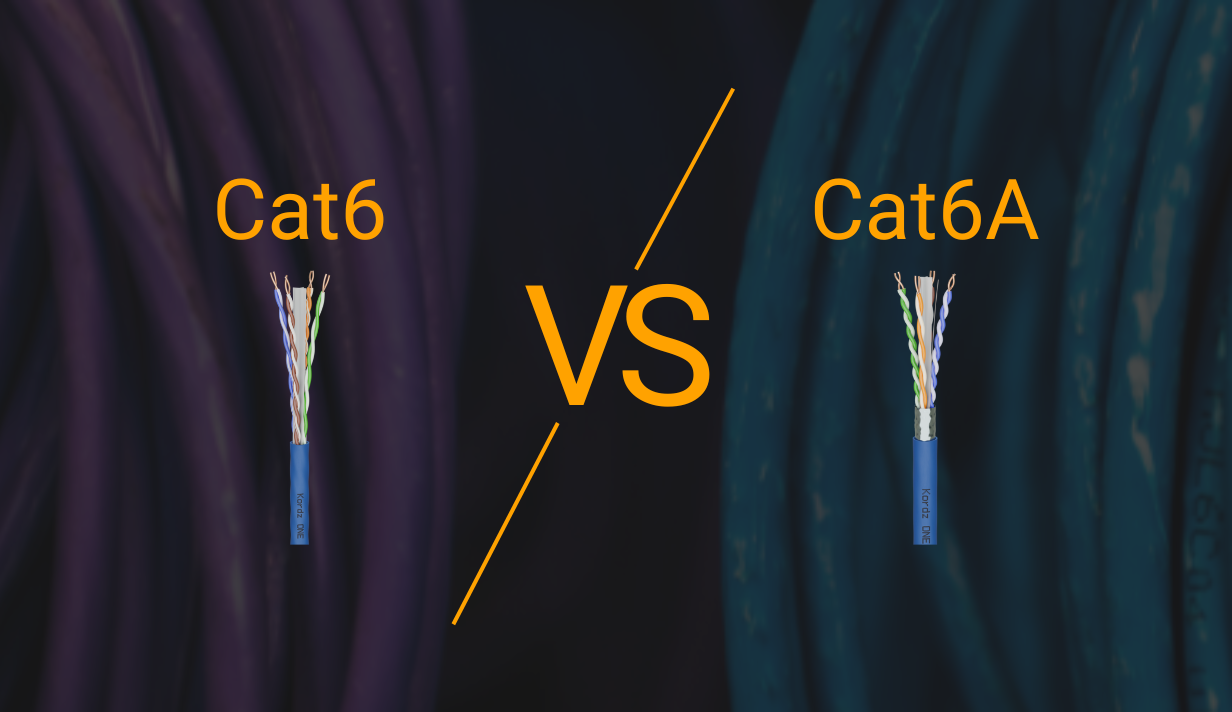
For most new residential and light-commercial runs for backbones, access points and high-demand networks, Cat6A cable is the baseline specification. Cat6 cable remains appropriate for shorter, lighter-duty drops where 10G over distance and long-term upgrade margin are not required. The decision is always about headroom, not the headline speed.
Cat6 vs Cat6A Is a Performance Margin Decision
Both Cat6 and Cat6A cable are capable of 10 Gbps data transmission; however, a speed-based cable choice is actually quite nuanced. Cat6A cable allows for 10G across the full 100m channel, whereas Cat6 supports 10G on shorter runs only. The tricky part is that this is very much condition-dependent.
The real decider is the headroom that the link holds under the actual installed conditions. Alien crosstalk levels, bundle heat, run length and installation quality all eat into what a cable can reliably deliver. The gap between the rated performance and real-world margin is where Cat6 and Cat6A cable genuinely differ, and it is rarely visible until the system is under load, usually when you’re at home with your feet up hoping the phone doesn’t ring.
For a broad overview of cable categories and how to choose the right specification, read:
Choosing the Right Network Cable: Performance, Environment and Future Requirements
Not sure which category fits your project?
Share your run lengths, PoE requirements, pathway constraints and expected network load with the Kordz team.
When Cat6 Cable Is the Right Call
Cat6 cable is the right call on many installs – the jobs with shorter runs, modest device counts, no heavy sustained PoE (which is more often the case), and no near-term plan to push the network harder. Also the jobs with standard endpoints where 1 Gbps, or 2.5G on a sensible length, is genuinely sufficient. Cat 6 cable costs less too.
So, if the run sits comfortably inside Cat6’s 10G window and the pathway and load are well understood, specifying Cat6 cable is not cutting corners – it is matching the specification to the job, which is at the heart of correctly specifying installations.
Cost and pathway constraints are real-world problems. That’s why when Cat6 cable genuinely makes sense, specifying it is the correct decision. Specifying Cat6A cable on every run regardless of the requirements is not diligence, it’s expedience.
Where Cat6 Cable Starts to Lose Performance Margin
Distance, and the conditions that come with it
The performance of Cat6 doesn’t fall over at a fixed distance; instead, margins erode gradually, and that is where smarter specifying decisions are required. Marginal links often pass at commissioning and become temperamental later under load. 10GBASE-T over Cat6 is commonly understood to have a real-world limit of between 37m to 55m, with alien crosstalk the governing factor under TSB-155-A and IEEE 802.3an. Those figures assume clean, well-installed, lightly bundled cable channels. Plus, ceiling voids and packed risers are rarely as convenient as installers wished they were. So this must all be factored in.
Audio Visual Signalling Over Cat6
HDBaseT and similar AV signalling protocols often specify Cat6 cable, but the performance requirements differ from those of standard Ethernet. HDBaseT operates at frequencies up to 500MHz, above the usual 250MHz ceiling to which Cat6 is rated. A cable that easily passes standard Cat6 certification may not deliver the signal integrity that HDBaseT demands.
In practice, cable rated to 500MHz is the most reliable choice for HDBaseT runs, even where distance sits comfortably within Cat6’s ethernet limits.
PoE and thermal behaviour
PoE behaviour is a separate but related concern. Both Cat6 and Cat6A cable easily carry PoE; what differs is their thermal margin under sustained load – loads you may not experience today but that will arise as PoE devices become more prevalent. Temperature rise in a bundled Cat run depends on conductor gauge, copper quality, DC resistance, construction, bundle size, ambient temperature and the installation practice. Cat6A cable is often the lower-risk choice in dense, high-power bundles – not because it is a different category but because its usual heavier conductor gauge construction typically allows for larger bundles within temperature-rise limits. So, this is a question of margin, not a binary yes or no.
Planning a PoE-heavy installation?
See how conductor size, bundle density, resistance and ambient temperature affect power delivery and cable temperature. Read PoE cable selection and thermal considerations .
System density
System density adds a third layer. As more APs, cameras and powered endpoints share pathways, alien crosstalk and bundle heat both increase simultaneously. So, consistently you see that margin you did not think you would need being spent quietly across multiple variables at once – before anything obviously fails. Cat6 cable works well within its operating parameters – the eternal question is whether those parameters are really as simple as the system survey suggested. Its easy to fall into the mistake of hoping that things will be easier than they turn out to be.
Furthermore, where routes run close to power, lighting control or electrically noisy equipment, shielding may also need to be considered—but it should be selected for the environment, not treated as a general category upgrade.
Wireless Demand Is a Wired Problem
Wi-Fi 6E and Wi-Fi 7 do not change cable infrastructure. Instead, they change what hangs off it, and that has direct consequences for how the infrastructure needs to be considered at the design stage. Any increased Wi-Fi pressure lands entirely on the wired side (unless you like playing service call roulette by specifying a purely Wi-Fi mesh network). Backhaul that once comfortably ran at 1 Gbps may now need to handle 2.5G, 5G or 10G uplinks, depending on the AP. Drops will need to carry higher sustained PoE loads. A wireless upgrade that overwhelms the wired infrastructure behind it will not deliver the performance for which your client is paying. Instead, it moves the bottleneck somewhere less obvious and harder to diagnose.
That’s why dependable wired backhaul matters much more than chasing after theoretical wireless throughput. After all, the Wi-Fi radio antenna is only as good as the cable feeding it power and data.
Designing for Wi-Fi 6E or Wi-Fi 7?
Review AP uplink speeds, switch capacity, PoE budgets and wired backhaul requirements before selecting your cable. Read the Wi-Fi 7 infrastructure guide .
When Cat6A Becomes the Safer Specification
Cat6A cable is warranted when the installation site conditions start stacking against Cat6’s available performance margin.
Long channels are the obvious shortcoming. Anything pushing the limits of Cat6’s 10G window or running through pathways that would make a re-pull genuinely painful, is usually a Cat6A decision. The same applies to Cat runs carrying sustained high-power PoE through dense bundles or warm ceiling voids, where thermal margin matters and Cat6A’s construction typically gives a little more of it.
AP (access point) backhaul is another clear case for Cat6A. Multi-gig uplinks, converged traffic and the expectation that the network will be driven harder over time all point in the same direction.
Backbone and high-demand horizontal runs sit in the same decision category., they aggregate traffic and they are the hardest routes to revisit. Frankly, the cost of getting them wrong is disproportionate to the cost saving on cable.
That’s why installs that are expected to serve for a decade without a re-pull need performance headroom built in from the start. Cat6A is exactly how you deliver that without guesswork.
Cost is a Risk Decision
The per-metre cost difference between Cat6 and Cat6A cable is real, but it is also the least important financial consideration in any networking conversation. Cable is by far the cheapest part of the install, yet seemingly the one that is most often haggled over. A lot of this likely stems from a wider misunderstanding that all Cats are created equal. Yet, the costs of labour, access equipment, callback visits and re-pulling in finished spaces can be significant, let alone the awkward conversation required with a client who expected a clean handover. So, once you factor in what pulling cable a second time actually costs, the economics of using Cat6A first time become obvious.
This is not an argument for specifying Cat6A cable everywhere, regardless of the site conditions. Where Cat6 cable genuinely fits the bill for the run, the load and the expected service life, it is the right choice and the cost saving is real.
However, where site conditions are marginal, the run is hard to access, or the install is expected to have significant longevity, the on-cost of upgrading to Cat6A cable from the outset is not the greatest risk; it’s what happens to the network when the performance margin runs out.
Physical Considerations of the Decision
Full-size Cat6A cable is thicker and stiffer than its Cat6 counterpart and it is a physical reality that needs to be accounted for when planning installations. Bend radius, pathway fill, rack density and termination geometry will all need more attention and consequently more time. In particular, pair geometry needs to be maintained carefully through the termination process, or the margin that the cable was specified to provide starts disappearing at the poorly terminated connector.
Cat6 cable pulls more easily and routes more naturally in tight spaces, so the risk is over-bundling and tight routing, both of which can erode the limited 10G and PoE headroom of which Cat6 cable already has less.
Slim (28AWG) Cat6A cable constructions ease the pathway and handling problem without abandoning the performance advantages. The trade-off is that a smaller diameter means something has been given up, sometimes maximum channel length, sometimes tighter PoE bundle limits. So, make sure you check the datasheet, rather than assuming parity with full-size.
Kordz PRS SlimCat (28AWG) Network Cable is one such option, rated to 10 Gbps at 50m and 100W PoE. SlimCat’s only compromise is its 50m length limit, so it’s useful where there are real pathway constraints, provided the channel length sits within its limits.
How to Choose Between Cat6 or Cat6A Cable for a Project
The Cat decision is best made after the survey and design stage, and importantly, before anything goes in the wall. You can assess this by:
- Checking the run lengths against Cat6’s real 10G window, not the headline and incidentally somewhat unrealistic real-world figure.
- Taking account of how the cable will be bundled and what sustained PoE load it will carry.
- Factoring in system density and how hard the network is likely to be driven, both now and in the future.
- Determining how long the install realistically needs to last and how painful a re-pull would be if the spec turns out to be marginal.
Ultimately, Cat6 cable is the sensible choice on shorter, lighter, well-understood drops. Cat6A cable is the safer choice on longer, loaded or hard-to-reach runs. The datasheet, the survey notes and a realistic view of the load are the tools for making that design and specification call. And where pathway constraints are a factor, consider whether full-size Cat6A cable is practical, or whether a slim construction is the better fit. Either way, check the datasheet rather than assuming all Cat6A performs identically.
Here is a handy comparison table:
| Factor | Cat6 | Cat6A |
|---|---|---|
| 10GBASE-T support | Conditional, shorter channels only | Full 100m channel |
| Typical 10G distance | Approx. 37 to 55m, alien-crosstalk and environment dependent | 100m |
| Behaviour near maximum length | Performance margin erodes; less forgiving | Performance margin retained |
| Sustained high-power PoE in bundles | Workable, but check gauge, bundle size and heat | Often more margin, subject to conductor size, construction and bundle limits |
| Typical bulk diameter | Smaller, more flexible | Larger, stiffer (full-size) |
| Pathway / bend radius / rack density | Easier in tight spaces | Tighter; plan pathways and terminations |
| Best fit | Shorter runs, modest load, well-understood drops | Long runs, multi-gig backhaul, dense or long-life installs |
Choosing Cat6?
Explore Cat6 systems for shorter, lighter-duty and well-understood runs.
View Cat6 solutionsChoosing Cat6A?
Explore Cat6A systems for long runs, AP backhaul, dense pathways and future-ready infrastructure.
View Cat6A solutionsCommon Specification and Installation Mistakes
- Specifying on the cable category type alone, without checking run length, data and PoE load or pathway conditions, is by far the most common error. This is especially applicable to those less experienced in network installations. The category itself is not a guarantee.
- A related problem is treating the headline distance figures as the installed-channel performance. Cat6 cable does not support 10G at 100m. Assuming it does, or that any Cat6 cable will behave identically, regardless of bundling or environment, is where performance erodes and marginal links start to appear.
- Over-bundling powered runs in warm ceilings and risers without considering thermal limits is easily overlooked at design stage and harder to fix afterwards. This might not show up immediately but as more devices move over to high-powered PoE, it could become a problem for your future self.
- Pairing a good quality Cat6A trunk with mismatched or legacy patch leads undoes the margin at the last connection. The overall channel is only ever as good as the weakest link.
- Assuming the system load will stay the same as it is today is one of the most fundamental mistakes of all. New products and new technologies added later will always stretch cabling infrastructure.
Decision Guide for Common Scenarios
Here is the specification guidance for five common scenarios framed by distance, load, density and lifespan.
| Scenario | Sensible default | Why |
|---|---|---|
| Standard residential AV | Cat6 to most outlets; Cat6A on long runs, AP drops and key backbones | Most endpoints sit at 1G or 2.5G on typical lengths; margin only matters on the harder runs |
| High-performance smart home | Cat6A for racks, media areas and high-load zones | Device density, sustained PoE and AP backhaul use margin up quickly |
| Home office / multi-gig | Cat6 for short point-to-point; Cat6A for long runs, shared pathways or 10G ambitions | 2.5G/5G ride existing copper, but 10G over distance and bundling wants Cat6A headroom |
| Light-commercial AV | Cat6A on most new infrastructure | Longer runs, higher density, converged services and expensive re-pulls |
| Backbone / high-demand runs | Cat6A or fibre, depending on distance, bandwidth and pathway | Aggregated traffic and hard-to-replace routes justify specifying for higher margin |
Need this comparison during surveys or specification meetings?
Related Kordz Solutions
For professional grade networking solutions that are built to last, Kordz ONE Cat6 U/UTP Network Cable covers home runs in residential AV where Cat6 is the right specification. For tighter pathways, dense racks and shorter runs, Kordz PRO SlimCat Cat6 Cable offers a slim construction up to 50m.
Where Cat6A is the right call, Kordz ONE Cat6A F/UTP Network Cable (23AWG) handles home runs in residential and light-commercial AV to 10 Gbps at 100m. Kordz PRS SlimCat Cat6A Network Cable (28AWG) covers constrained pathways, AP drops and runs up to 50m.
Ready to source the right network system?
Find a Kordz distributorRelated Topics
Choosing the Right Network Cable: Performance, Environment and Future Requirements: Compare network cable categories and understand how bandwidth, distance, installation environment and future requirements shape the right specification.
Designing Network Infrastructure for Wi-Fi 7 and Wi-Fi 6E: Plan Cat6A or Cat6 backhaul, PoE budgets and switch uplinks for dependable Wi-Fi 6E and Wi-Fi 7 installations.
PoE Demystified: Power, Performance and Cable Considerations: Learn how power delivery impacts cable performance, heat and long-term system reliability.
Shielded vs Unshielded Network Cable: What Should You Specify and When? Learn when electrical interference justifies shielded cabling—and why every component in the channel must be compatible.
FAQs
Is Cat6A cable always the safer choice?
No, not always. On short, lightly loaded runs Cat6 cable is often the correct and economical choice. Cat6A is warranted where distance, sustained PoE, bundle density or a long service life start compressing the margin Cat6 can offer.
How far can Cat6 cable actually carry 10 Gbps?
Cat 6 cable cannot carry 10 Gbps to the full 100m. 10GBASE-T over Cat6 is condition-dependent, commonly cited around 37m to 55m, depending on alien crosstalk and installation quality. Treat anything approaching that range, or heavily bundled, as a Cat6A decision.
Does PoE decide the Cat6 vs Cat6A question on its own?
No, both Cat6 and Cat6A cables can carry PoE. Thermal behaviour under sustained load depends on conductor gauge, DC resistance, cable construction, bundle size, ambient temperature and installation practice, not the category alone. Cat6A cable often gives more thermal margin in dense, high-power bundles, as it’s usually made with larger gauge conductors. For this reason, it is frequently the lower-risk choice for new PoE-heavy installs.
Is Cat6A cable much harder to install in tight spaces?
Full-size Cat6A cable is thicker and stiffer, so bend radius, pathway fill and terminations require more care and skill. Slim Cat6A cable constructions ease this considerably, within their own channel-length limits.
Can a compact Cat6A cable replace full-size Cat6A cable?
Yes, within the rated limits. In the case of Kordz SlimCat cables, the trade-off for the smaller diameter of its compact construction is a shorter maximum channel length of 50m, which means it is still highly suitable for most standard residential installs, rack build and retrofit situations.
Will Cat6 cable hold up for Wi-Fi 6E and Wi-Fi 7?
It depends on the run, not the wireless standard. Cat6 cable can serve 2.5G and often 5G backhaul on sensible lengths. Cat6A cable gives the consistent 10G and PoE headroom that denser, higher-throughput AP deployments may need. See our article Designing Network Infrastructure for Wi-Fi 6E and Wi-Fi 7 for more information.
Can I mix Cat6 and Cat6A cables in the same project?
Yes, and on many projects it makes sense to do so. Choose Cat6A cable on AP drops, long runs and backbones, and Cat6 cable on shorter standard endpoint drops where the load and distance are well within limits. The important point is that you specify each run for its own conditions. The weakest link governs the channel, so a Cat6 segment or a legacy patch lead in an otherwise Cat6A run sets the performance ceiling for that link, regardless of what the rest of the channel is built from.
Can I use Cat6 cable for 2.5G or 10G Ethernet?
Yes, Cat6 cable can support 2.5G and 10G Ethernet on a typical, well-installed run. The decision becomes more sensitive when runs are long, heavily bundled, PoE-heavy, or expected to support 10G later, in which case Cat6A may be the more reliable choice.
Does Cat6A cable improve PoE performance?
Cat6A cable does not improve PoE by category name alone. PoE performance depends on conductor size, copper quality, DC resistance, bundle size and ambient temperature. Many Cat6A cables provide more thermal and electrical margin because of their construction.
Conclusion
Cat 6 or Cat6A? Either way, you install a cable in the wall – so, the real question is how much performance margin the project needs and how much it will cost if that margin turns out to be insufficient.
That’s why you can make a confident choice by matching the specification to the run, the load and the expected service life, instead of guessing.
Use Cat6 cable where it is genuinely sufficient – on the shorter, lighter, well-understood drops. Use Cat6A cable where site conditions require more – whether that’s longer, loaded or harder-to-reach runs, and where you’d like to avoid awkward client conversations about re-pulling cable down the track. As always, it’s best to get it right at design stage – it’s considerably easier than correcting course later.
© 2026 Kordz International. All Rights Reserved.
Please note, re-publishing of the contents of this article is prohibited; however, Kordz encourages the link to this page to be shared. If media, distributors, educators or others wish to share this information, we request you author your own post or article and link it to this page on kordz.com.